
Your Guide to CDT Coding Mistakes and Revised CDT Codes for 2026
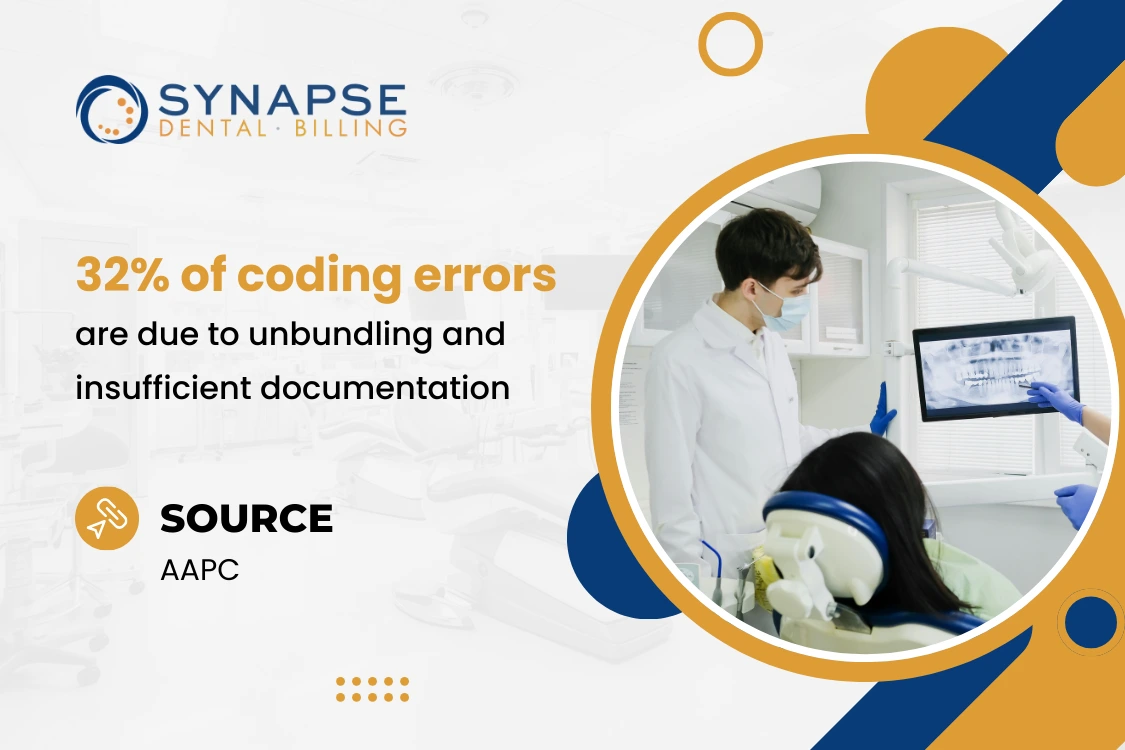
A recent AAPC audit of 2,600 dental claims uncovered a significant coding problem: 14% contained errors, yielding an average Current Dental Terminology (CDT) code accuracy rate of just 79%.
These inaccuracies are more than simple mistakes; they directly threaten revenue, create compliance risks, and can harm patient trust. With the revised CDT codes for 2026 on the horizon, understanding these common errors is now critical.
In this article, we will outline the most frequent CDT coding mistakes identified by the AAPC and provide the key updates you need to know for a compliant and profitable 2026.
6 Common Coding Mistakes acc to AAPC
In 2023, AAPC Services audited dental claims for 10 population health and community health centers. There were 260 providers and 2,600 claims. The audit revealed six major sources of CDT coding errors:
1. 14% of errors involve over-coding of oral evaluations, screenings, and consultations.
This occurs when a dentist bills for a separate evaluation service that is already included in another procedure performed during the same visit.
- For example, using a Comprehensive Oral Evaluation (D0150) for a Limited Oral Evaluation (D0140) is over-coding.
- In another instance, you can’t bill Periodic Oral Evaluation (D0120) for a routine cleaning (prophylaxis, D1110).
- Moreover, you can’t bill a Consultation (D9310) in addition to the root canal procedure (D3340) on the same day after a general dentist has already made the diagnostic service.
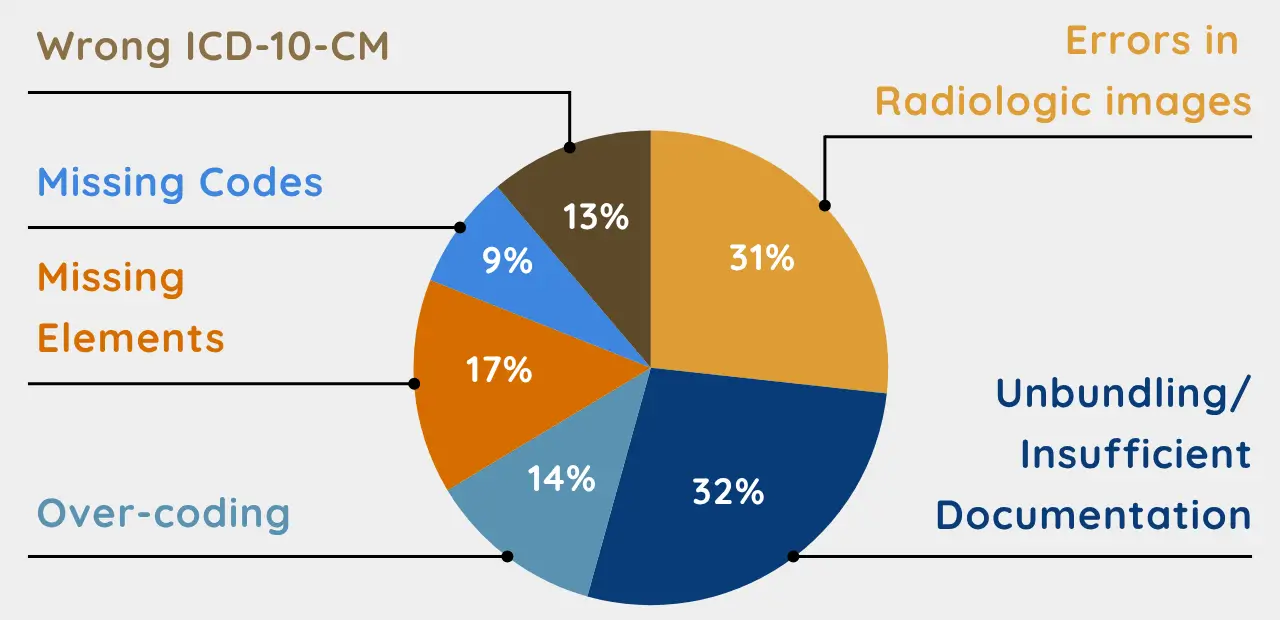
2. 31% of errors involve radiologic images.
A claim is denied when radiologic images are unbundled or lack sufficient documentation to support the number of films/bitewings billed.
- “Unbundling” means billing multiple procedure codes for components of a single, comprehensive procedure that has its own specific code. Hence, the insurer pays multiple fees that add up to more rather than one fee for the radiologic image.
- Insufficient documentation means the patient's clinical record does not provide sufficient evidence to justify the number and type of X-rays billed.
- Both can commonly misuse these CDT codes:
D0330: Panoramic radiographic image
D0210: Intraoral - complete series of radiographic images
D0230: Intraoral - periapical each additional radiographic image
D0272: Bitewings - two radiographic images
D0220: Intraoral - periapical first radiographic image
D0277: Vertical bitewings - 7 to 8 radiographic images
D0274: Bitewings - four radiographic images
D0270: Bitewings - single radiographic image
D0350: 3D photographic image
D0367: Cone beam CT image capture with interpretation
3. 17% of errors are due to missing elements on claims,
such as the Universal Numbering System (UNS) for teeth or tooth surfaces on the claim form.
4. 9% of errors involve missing the D1330 code for oral hygiene instructions.
5. 13% of errors are wrong codes being reported with ICD-10-CM codes.
6. 32% of errors involve unbundling and/or insufficient documentation of procedures.
Why knowing these CDT costing mistakes matters
CDT codes are the language you use to communicate with insurance companies. Misusing this language can lead to a cascade of problems–the first and most significant being a hit on your financial health.
The American Medical Association (AMA) reported that one psychiatrist was fined $400,000 and permanently excluded from taking part in Medicare and Medicaid, in part due to upcoding.
Claim denials cost hospitals roughly $262 billion per year, creating significant cash flow issues.
A Crowe RCA benchmark analysis notes that in 2022, 11% of all claims were denied, equating to 110,000 unpaid claims for an average-sized health system.
Coding errors not only drain your practice’s money but also result in potential exclusion from insurance networks or government programs. Thus, putting your relationship with your patients on the line.
That’s why you need to get CDT coding right because it ensures the following:
You get paid accurately and on time for the work you do.
You stay compliant and avoid devastating audits.
You continue to build unwavering trust with your patients.
As Albagmi et. al. put it into words, clinical coding “helps in the development of an administrative database utilized for reimbursement, financial reconciliation, audit, and research purposes."
Revised CDT codes for 2026 that you need to know
According to ADA, the CDT 2026 has 60 code changes, including 14 revisions. Here, we have compiled some of the coding changes for you to review.
For more information, please refer to The CDT 2026, the Coding Companion Kit, and the Consumer-Friendly CDT 2026: Plain Language Terms for Patient Communication, all available for purchase at ADAStore.org.
Dental Coding with Confidence, Partner with Synapse
At Synapse Dental Billing, our specialized billing and RCM services ensure every claim is meticulously coded, thoroughly documented, and fully compliant with the latest guidelines.
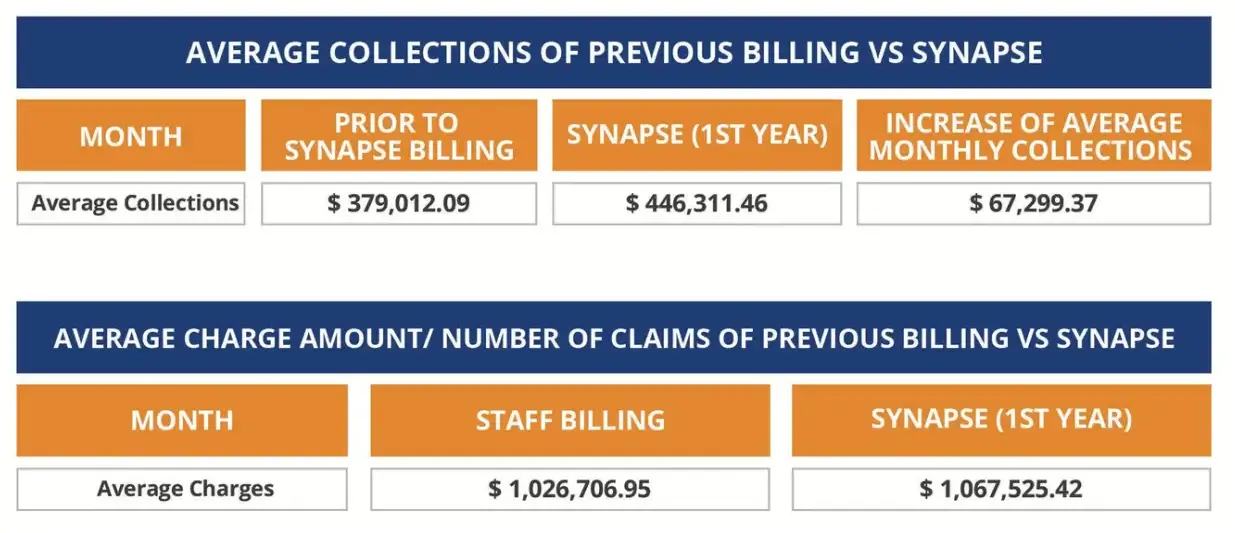
Take a look at how our initial review became an important tool in increasing collections and accurate billing of a multi-specialty practice, resulting in their highest collection at $627,500.24.
With highly skilled and trained billers in your arsenal, you can have the peace of mind:
You'll know your codes meet payer-specific and ADA guidelines, dramatically reducing your audit risk.
You'll be confident you're capturing the full value of your services, eliminating over-coding and preventing denials from incorrect codes.
Your team will be free from the constant burden of code updates and claim follow-up, leading to a smoother, more productive practice.
Ready to transform coding from a source of stress into a pillar of your practice's financial health?
Let's connect!
Sources
Albagmi, S., Shawaheen, M., Asiri, E. M., & Alqadeer, T. A. (2023). Assessment of clinical miscoding errors and potential financial their implications on healthcare management – A case of local hospital in Najran, Saudi Arabia. Saudi Pharmaceutical Journal, 32(1), 101894.
https://doi.org/10.1016/j.jsps.2023.101894
Chandawarkar, R., Nadkarni, P., Barmash, E., Thomas, S., Capek, A., Casey, K., & Carradero, F. (2024). Revenue cycle management: The art and the science. Plastic and Reconstructive Surgery. Global Open, 12(7), e5756–e5756.
https://doi.org/10.1097/gox.0000000000005756
Dental Claims Case Study. (2024). Aapc.com.
https://www.aapc.com/resources/minimizing-errors-in-dental-claims-insights-from-an-aapc-audit?srsltid=AfmBOopX-C2CSTvQdjyO9khHqZirPNYB2ir82lxn1k2rQmwf7aPssQGL
Hospital double whammy: Less cash in, more cash out. (2022). Crowe RCA benchmarking analysis.
https://www.crowe.com/-/media/crowe/llp/widen-media-files-folder/h/hospital-double-whammy-less-cash-in-more-cash-out-chc2305-001b.pdf?rev=91d36c682ee744b1ab4bcb56cb769bc1&hash=9A63564E3DBD39914F3674540158857E
O’Reilly, K. (2025, May 20). Medical coding mistakes that could cost you. American Medical Association.
https://www.ama-assn.org/practice-management/cpt/medical-coding-mistakes-could-cost-you